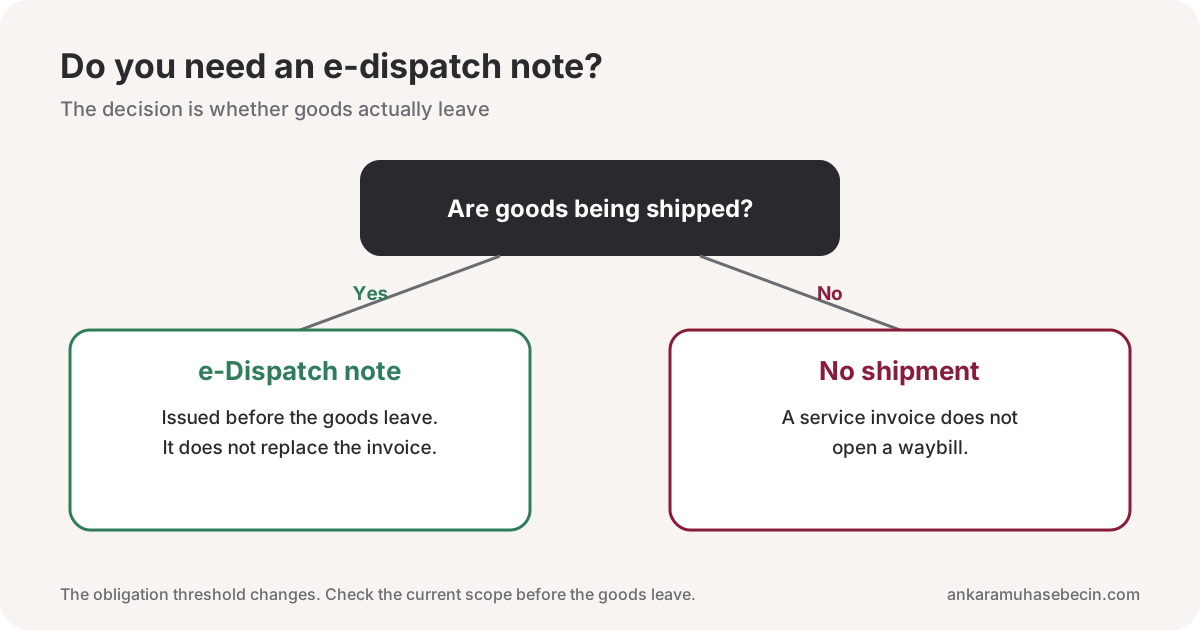
Short answer: An e-dispatch note is the electronic waybill for a shipment of goods. An e-Invoice is the invoice for the price of a sale. When goods leave, the dispatch note is the document. When the price is charged, the invoice is the document. One does not replace the other. The obligation threshold changes. The current scope is checked against the Revenue Administration notice before the goods move.
The question that comes up on a parcel leaving a warehouse in Ankara is whether the invoice closes the waybill. It does not. The invoice tells the buyer the price. The dispatch note tells which day, which vehicle and which quantity left. An office that sells services and ships no goods does not reach for a waybill. A business that sells physical goods keeps both.
Is an e-dispatch note the same document as an invoice?
No. An e-Invoice is a sale to a buyer registered on the e-Invoice system. If the buyer is not registered, or is a consumer, the document is an e-Archive invoice. That split is in e-Invoice vs e-Archive. The e-dispatch note sits outside that choice and looks at the movement of the goods. A sales invoice does not mean the shipment was completed without a waybill. The reverse is also true. A dispatch note does not mean the price has been charged.
A paper waybill and an e-dispatch note do the same job. The difference is that the document is issued and sent electronically. A business inside the scope does not skip the duty by closing the shipment on paper. The scope is announced by turnover and by activity. Memorising an old threshold does not save today’s shipment.
| e-Dispatch note | e-Invoice or e-Archive | |
|---|---|---|
| What it records | The shipment of goods | The price of the sale |
| When | Before the goods actually leave | When the price is charged |
| Typical carrier | Warehouse, cargo, vehicle | The customer account |
| What it does not replace | The invoice | The waybill |
Which day splits the shipment from the collection?
Goods can leave the warehouse before the invoice day. The dispatch note holds that departure. The invoice is issued when the price is fixed. On a marketplace, the shipment has started when the carrier collects the parcel. The seller’s payout reaches the bank after commission and returns. Matching that payout is in marketplace payout reconciliation. The dispatch note does not calculate the payout. It only shows that the goods left.
Returned goods are a movement too. A return invoice corrects the price. The dispatch note records that the goods came back. If either is missing, stock and the customer account split. At month end that split also inflates profit. The berat does not correct the inflation. Sending the books is in e-Ledger berat upload.
Who needs one, and who does not?
An e-dispatch note is looked for where goods are shipped and the business is inside the Revenue Administration’s scope for that period. An office that invoices services and ships nothing does not open a shipment document. A business outside the scope can join voluntarily. The switch, like the e-Invoice switch, needs a financial seal or an electronic signature, a portal or an integrator, and a document template. The logic of the steps matches the transition in the invoice article. The thresholds are not the same list.
Even if someone else carries the goods, the shipment document stays on the file of the party that sent them. The carrier’s own transport record does not replace the seller’s e-dispatch note. The vehicle, the quantity and the buyer on the note should not contradict the invoice line. A contradictory line breaks both the stock count and the buyer’s acceptance.
Setup is on the e-Transformation page. The marketplace seller’s tax routine is also in the tax guide for marketplace sellers. The VAT calculator splits an inclusive amount as a rough figure. The dispatch note is not the VAT calculation itself.
How is a partial shipment documented?
One order can leave on more than one day. Each actual departure needs its own dispatch note. The invoice can be one document when the price is fixed, or one invoice per shipment. The number of notes and the number of invoices do not have to match. What has to match is the total quantity. If two parcels of three have left, the note says two. If the invoice already includes the parcel that has not left, stock and the customer account split.
When the shipment and the invoice fall on the same day, the documents can carry the same date. The same date does not make them the same type. The note carries the vehicle and the quantity. The invoice carries the price and the VAT. Copying one onto the other and keeping a single file leaves both duties short. If the buyer accepts only part of the goods, the quantity refused is visible on both the note and the invoice. An oral “we will invoice the rest later” does not close the stock count.
A transfer between warehouses is a movement too. There may be no sale. The goods have still changed place before any price is invoiced. That transfer is not closed with a sales invoice. The dispatch note names the warehouse of departure and the warehouse of arrival. If there is a sale, the invoice is issued separately. Goods moving from a warehouse in Çankaya to one in Yenimahalle fall under the same split. Staying inside Ankara does not remove the note. What removes it is that no goods actually leave.
Mistakes that repeat
- Issuing the invoice and closing the shipment without a waybill.
- Treating the dispatch note as the invoice because the price was collected.
- Counting the carrier’s receipt as the seller’s e-dispatch note.
- Issuing only a return invoice for returned goods and leaving the return waybill blank.
- Copying an obligation threshold from an old blog post.
- Leaving the vehicle, the quantity or the buyer in conflict with the invoice.
A service export that ships no goods does not create a waybill either. The tax exemption for a service supplied abroad depends on conditions that are separate from the document type. Those conditions are in service export tax exemption. An office that sells software or design and ships no parcel does not enter the shipment line of this guide. An e-commerce seller that ships a physical product does.
A warehouse in Çankaya still owns the document when the buyer is in another province. The district does not change the e-dispatch threshold. The activity and that period’s notice do. The office is in Kızılay. The shipment file is watched on the same calendar as the returns.
Frequently asked questions
Does an e-dispatch note replace the invoice?
No. The e-dispatch note records the shipment. The invoice records the price. They are separate documents.
Does a service invoice need an e-dispatch note?
If no goods leave, a shipment document does not come up. The e-dispatch note is discussed for goods that are actually shipped.
Is the carrier’s receipt enough?
The carrier’s own record does not replace the seller’s e-dispatch note. A seller inside the scope issues their own document.
Is the note issued after the goods have left?
No. The document is issued before the goods actually leave. The invoice is issued separately when the price is charged.
Is the obligation threshold fixed?
No. The Revenue Administration updates the thresholds. The current notice is checked before the shipment. A figure in an old article is not the source.
Which document does a return need?
A return invoice corrects the price. A waybill records that the goods came back. If either is missing, stock and the customer account split.
Conclusion
The e-dispatch note shows that the goods left. The e-Invoice or e-Archive invoice shows that the price was charged. One does not replace the other. The document is issued before the goods leave. The obligation threshold changes and is checked before the shipment.
Ankara Muhasebeci keeps the shipment document on the same file as the invoice and the books, from the Kızılay office. To talk through your own shipments, see e-Transformation or write to us.