
Short answer: Marketplace payout reconciliation means matching the amount the marketplace pays you, item by item, with your sales invoices, the commission and shipping invoices issued by the marketplace, returns, campaign contributions and any tax withholdings. It should be done for every payment period by comparing the order report, the invoice list and bank transactions. This way, short payments, duplicate deductions and uninvoiced sales are caught in time.
The most common problem for marketplace sellers is that the amount paid into the bank never equals total sales. In between are commissions, shipping, returns and campaign deductions. If these are not matched correctly, profitability is misjudged and tax returns may be wrong. In this guide, we at Ankara Muhasebeci explain reconciliation step by step.
Below you will find an illustrative payout calculation, a table of documents, a step-by-step check, the most common causes of differences and short answers to frequent questions.
What is a payout and why is it lower than sales?
The payout (hakediş) is the amount the marketplace transfers for a period after deductions. The difference usually consists of:
- Commission: the marketplace's fee per sale, for which it issues you an invoice.
- Shipping: contracted shipping costs, usually deducted from the payout.
- Returns: returned items may be offset against later payouts.
- Campaign contributions: the seller's share of promotional discounts.
- Tax withholdings: the law may require withholding on marketplace payments; track these separately in statements.
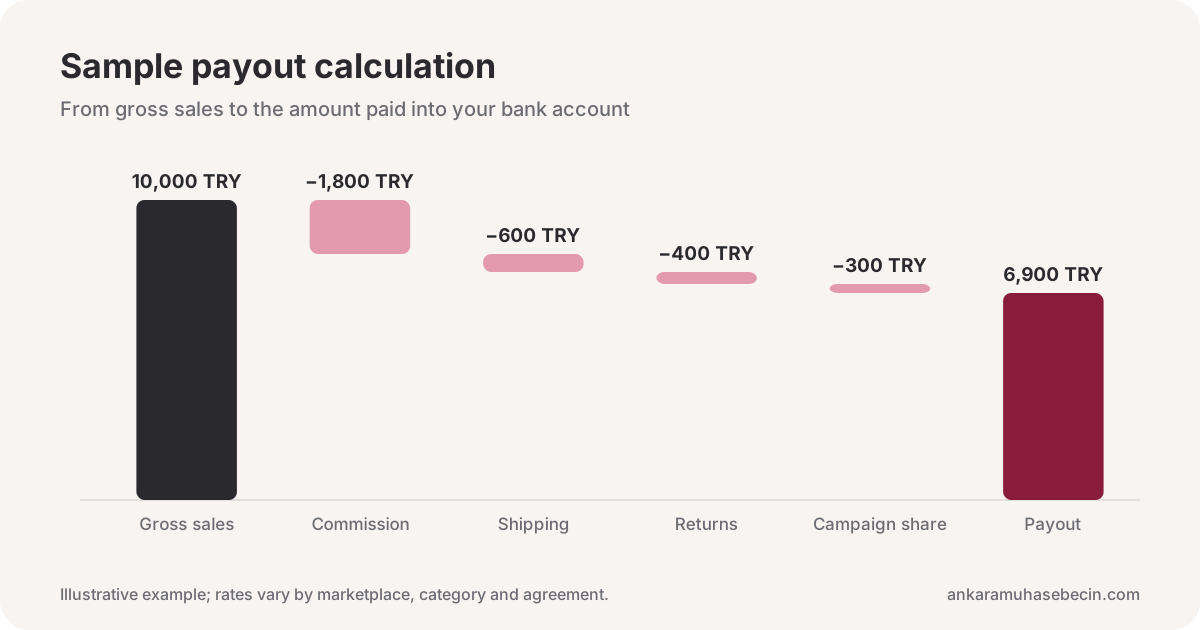
In this illustrative example, gross sales of TRY 10,000 less commission, shipping, returns and campaign share leave TRY 6,900 paid into the account. In the books, the sale is invoiced at TRY 10,000; commission and shipping are recorded as separate expense invoices and returns are handled separately.
Documents for reconciliation
| Document | Source | Purpose |
|---|---|---|
| Order and sales report | Marketplace seller panel | List of all sales in the period |
| Sales invoices | e-Archive or e-Invoice software | Check every order is invoiced |
| Commission and service invoices | e-Invoices from the marketplace | Record deductions as expenses |
| Shipping invoices | Marketplace or carrier | Verify shipping costs |
| Payout statement | Marketplace seller panel | See which orders a payment covers |
| Bank statement | Bank | Confirm the payment actually arrived |
Step-by-step reconciliation
- Set the period: align it with the marketplace's payment cycle (weekly, biweekly or monthly).
- Match orders to invoices: no order should be left without a sales invoice.
- Match deductions to invoices: compare commission and shipping deductions with the marketplace's invoices.
- Separate returns: list returned orders with their return transactions.
- Compare with the bank: match the net payout to the bank statement.
- Record differences: raise unexplained differences with seller support and keep the answers.

Building a simple reconciliation sheet
You do not need expensive software; a well-designed spreadsheet is enough for most businesses. Use one row per order with these columns:
- Order number and date: exactly as in the marketplace report.
- Invoice number: the sales invoice for the order.
- Gross sale: VAT-inclusive amount paid by the customer.
- Commission, shipping and other deductions: one column each.
- Expected net: gross less deductions.
- Amount and date paid: from the payout statement and bank.
- Difference and explanation.
Rows with zero difference are closed; focus only on the rest.
Most common causes of differences
- Period shift: month-end orders are paid the following month.
- Late returns: refunds may be offset weeks after the sale.
- Category-based commission: different rates for different product groups.
- Extra services: advertising, promotion or storage fees deducted from payouts.
- Shipping adjustments: extra charges for size or weight differences.
How returns and campaigns affect the books
A return does not cancel the original sales invoice; it must be documented and recorded separately, and the treatment can vary with invoice type and timing. If the item goes back into stock, update stock records. Campaign contributions may be deducted from the price or appear as a separate deduction; knowing which applies ensures sales invoices show the right amount. Reconcile more often during campaigns.
What a reconciled month looks like
At the end of a well-reconciled month, you should be able to answer four questions in a few minutes: how much you sold, how much the marketplaces deducted and why, how much was actually paid into your account, and which amounts are still pending. Every sale has an invoice, every deduction has a marketplace invoice, returns are listed separately and any open difference has a note and a support ticket.
This summary is also exactly what your financial advisor needs to prepare VAT and income or corporate tax returns. When the reconciliation is done on your side, the accounting work becomes faster, cheaper and less error-prone, and you get a clear picture of which products and channels actually make money.
Selling on several marketplaces
Each marketplace has its own payment cycle, report format and deductions. Keep a separate sheet per marketplace and combine them in a monthly summary. If you also sell on your own website, track payment provider transfers separately. See our tax guide for marketplace sellers and, if you have not formed your business yet, starting an e-commerce company.
Suggested reconciliation calendar
- After each payment: download the statement, compare with the bank and note differences.
- Weekly: check for uninvoiced orders.
- Month end: send commission and shipping invoices and a list of returns to your advisor.
- Quarterly: review profitability per marketplace.
Consequences of skipping reconciliation
- Missing invoices: uninvoiced sales can cause problems in a tax audit.
- Wrong profitability: unrecorded deductions overstate profit.
- Lost receivables: short or late payments go unnoticed.
- Incorrect VAT: VAT on commission invoices not deducted means overpaying.
Our VAT calculator helps separate VAT amounts quickly.
Frequently asked questions
Why is my payout lower than my sales?
The marketplace deducts commission, shipping, returns, campaign contributions and any legally required withholding before transferring the rest.
Is the sales invoice issued on the payout amount?
No. It is issued for the full sale amount to the customer. Commission and shipping are recorded as expenses based on the marketplace's invoices.
How often should I reconcile?
Ideally every payment period. Leaving it to month end makes it harder to trace differences.
Can I deduct VAT on commission invoices?
If you are VAT-registered, VAT on work-related commission and shipping invoices can be deducted, provided they are fully recorded.
What if a difference cannot be explained?
Note it with the order number and ask seller support. Keep the written answer in your reconciliation file.
Do I need special software?
No. A sheet with order, invoice, deduction and payment columns is enough for most businesses; integration tools help as volume grows.
Conclusion
Payout reconciliation is the backbone of e-commerce accounting. Matching sales, deductions and bank transactions every period means correct profitability, correct tax and no lost receivables. Treat it as a regular health check rather than a month-end chore: small differences are easy to fix, while those found months later cost time and money. Whether you sell on one marketplace or several, the same method applies: one row per order, one column per deduction and a clear note for every difference.
At Ankara Muhasebeci, we handle payout reconciliation, invoicing and tax returns for marketplace sellers. See our e-commerce accounting page, or reach us via the phone and WhatsApp line on our contact page.