
Short answer: A financial advisor (mali müşavir) keeps a business's books, prepares and files its tax returns, runs payroll and social security procedures, and advises on tax and regulatory matters. In Turkey, the profession is governed by Law No. 3568, which defines two titles: certified public accountant (SMMM) and sworn financial advisor (YMM). Day-to-day accounting is handled by an SMMM; a YMM does not keep books but certifies certain transactions.
In everyday Turkish, "muhasebeci" (accountant) and "mali müşavir" (financial advisor) are often used interchangeably. Legally, however, the titles carry different powers and responsibilities. In this guide, we at Ankara Muhasebeci explain what a financial advisor does for your business, how an SMMM differs from a YMM and how to get the most out of the service.
Core duties of a financial advisor
The work a certified public accountant does for businesses falls into five main areas:
- Bookkeeping: purchase and sales invoices, bank transactions and expenses are recorded in the statutory books, on a balance sheet, business account or freelance income basis depending on the business.
- Tax returns: VAT, withholding and social security, provisional tax and annual income or corporate tax returns are prepared and filed on time.
- Payroll and social security: hiring and termination notices, monthly payroll and contribution declarations are prepared.
- e-Transformation: e-Invoice, e-Archive and e-Ledger processes are set up and monitored.
- Advisory: guidance on tax planning, incentives and exemptions, and choosing a company type.
The exact scope varies from business to business. We explain each item in what does an accounting service include.

SMMM vs YMM: what is the difference?
Law No. 3568 defines two separate titles. A certified public accountant (SMMM) can keep books, prepare tax returns and provide advisory and audit services. A sworn financial advisor (YMM) earns the title after a period of professional experience; a YMM cannot keep books or run an accounting office but can certify (tasdik) transactions where the law requires it.
Certification means the YMM confirms that certain transactions and declarations comply with the legislation. VAT refund reports and full certification engagements are among the most common YMM assignments.
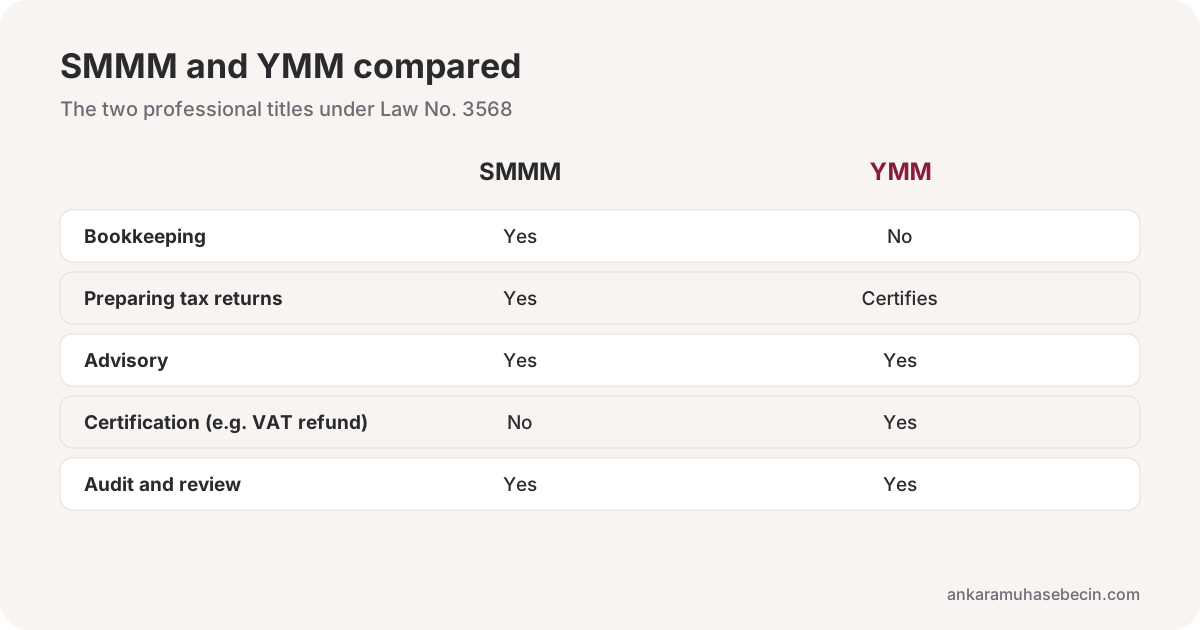
| Topic | Certified public accountant (SMMM) | Sworn financial advisor (YMM) |
|---|---|---|
| Legal basis | Law No. 3568 | Law No. 3568 |
| Bookkeeping | Yes | No |
| Tax returns | Prepares and files | Certifies where the law requires |
| Certification | No | Yes |
| Advisory | Yes | Yes |
| Typical clients | Businesses of almost any size | Businesses needing certification |
Is a financial advisor the same as an accountant?
In everyday use, "accountant" usually means a certified public accountant. The person who keeps your books and signs your returns must hold an SMMM licence and be registered with the chamber. In-house accounting staff handle internal work, but responsibility for official returns usually remains with the external financial advisor.
We explain step by step how to verify a professional's authority in how to choose an accountant in Ankara.
Where does a financial advisor guide you?
A financial advisor's value goes beyond filing on time; it lies in warning you at the right moment. The most common topics are:
- Company type: sole proprietorship or limited company, assessed against income, partners and growth plans. See sole proprietorship or limited company.
- Tax calendar: deadlines and amounts are communicated in advance.
- Incentives and exemptions: eligibility for schemes such as the young entrepreneur exemption or the service export exemption.
- Cash planning: provisional tax and VAT payments are forecast each period.
- Documents: which expense needs which document is made clear.
Where does the business's responsibility begin?
The advisor keeps the records and files the returns, but delivering correct documents on time is the business's responsibility. Sending all invoices, sharing bank accounts and reporting staff changes promptly are preconditions of sound accounting. Paying taxes on time also remains the taxpayer's duty.
Our monthly accounting document checklist makes the document flow easier, and the monthly tax calendar shows when returns are due.
Which businesses need a financial advisor?
Almost every business with bookkeeping obligations works with a certified public accountant: sole proprietorships, limited and joint stock companies, freelancers, e-commerce sellers and independent couriers among them. As a business grows, so does its need for advice; businesses claiming VAT refunds or subject to full certification may also work with a sworn financial advisor.
What does a financial advisor do during a month?
- First week: the previous month's invoices, expense documents and bank transactions are collected, and missing documents are flagged.
- Second and third weeks: entries are posted, payroll is prepared and VAT and withholding are calculated.
- Before filing: the amounts of tax and contributions due are shared so cash can be planned.
- Final days: withholding and social security and VAT returns are filed and assessments are sent to the business.
- Month end: Ba-Bs forms are submitted if required and e-Ledger berats are tracked.
Provisional tax returns are added every quarter and the annual income or corporate tax return once a year.
What reports should you expect?
- Assessment and payment summary: which tax or contribution is due and when.
- Periodic profit and loss view: income and expenses for each provisional tax period.
- Year-end financial statements: balance sheet and income statement.
- Alerts: regulatory changes, upcoming obligations and risky entries.
Agree on the frequency and format of these reports at the start.
Practical notes for working with an advisor in Ankara
Businesses in Ankara deal regularly with their tax office, the Ankara Chamber of Commerce or the relevant tradesmen's chamber, and the social security institution. Your advisor helps track correspondence, inspections and notifications with these bodies. Checking your electronic notification (e-Tebligat) inbox regularly is especially important so that no deadline is missed.
Documents are now shared digitally, but powers of attorney, signatures and some official procedures still require a meeting. A central office in Kızılay, easily reached by public transport, makes this simple for businesses from all districts of Ankara.
Frequently asked questions
What does a financial advisor do?
A financial advisor keeps the business's books, prepares and files tax returns, runs payroll and social security procedures and advises on tax and regulatory matters.
What is the difference between an SMMM and a YMM?
An SMMM can keep books, prepare returns and advise. A YMM does not keep books; it certifies transactions where the law requires, for example in VAT refund reports.
Is a financial advisor the same as an accountant?
The terms are used interchangeably in daily speech. Officially, the authority to keep books and file returns belongs to a licensed, chamber-registered certified public accountant.
Is a financial advisor liable for my tax debt?
The obligation to pay tax rests with the taxpayer. The advisor's responsibility is limited, as set out in the legislation, to the returns and documents they prepare and sign.
Does a small business need a financial advisor?
Every business with bookkeeping and filing obligations needs one. Even for small businesses, an advisor reduces the risk of incorrect filings, late interest and penalties.
When should I hand over my documents?
Ideally in the first week after the month ends, so that entries and returns are prepared without a last-minute rush.
Conclusion
A financial advisor is a business partner who keeps your financial records in line with the law and meets your tax obligations on time. Knowing the difference between an SMMM and a YMM tells you whom to approach for which need. The key to working well with an advisor is a regular document flow and open communication. When roles are clear from the start, filing periods pass smoothly and you can focus on your business.
At Ankara Muhasebeci, we provide bookkeeping, tax filing, payroll and tax advisory services from our office in Kızılay. See our tax advisory and bookkeeping and accounting pages for details.