
Short answer: Regular sales on a marketplace create a tax registration. Sales to consumers are usually documented with an e-Archive invoice. If the buyer is an e-Invoice user, you issue an e-Invoice. Commission, shipping and advertising invoices from the marketplace are expenses. The return does not close until the payout, the sales invoices and the bank movement agree for the same month.
Trendyol, Hepsiburada, Amazon and similar platforms follow the same logic. The name of the platform changes. The type of document does not. In Ankara seller files the break is usually the month-end payout not matching the sales invoices. The matching steps are in marketplace payout reconciliation. Document types are in e-Invoice vs e-Archive.
Registration and the sales documents
A person who sells regularly does not stay outside the tax net because the platform "already withholds something". Marketplaces ask for a tax certificate. A sole proprietorship is enough for many files at the start. A limited company is considered when turnover, partners or corporate buyers grow. That move is not a change of sign. See sole proprietorship or limited company and starting an e-commerce company.
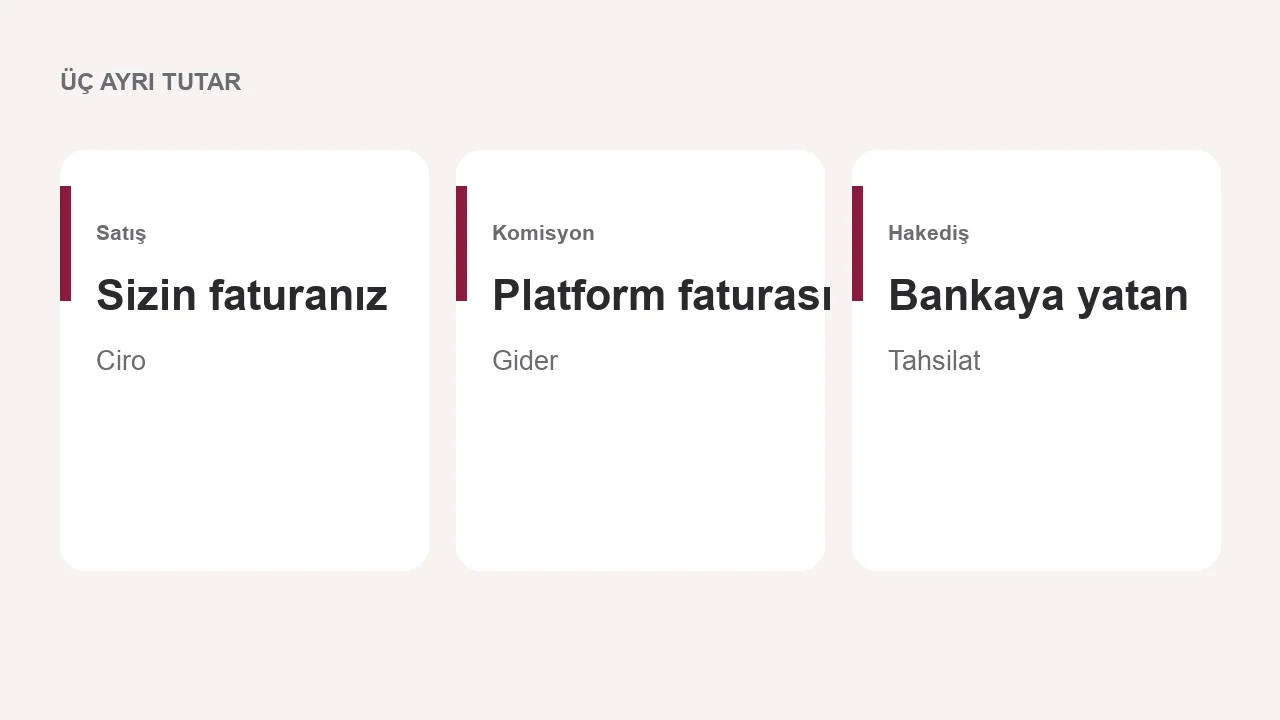
Your sales invoice and the marketplace's commission invoice are different documents. A return does not delete the sales invoice. It is recorded with a return document in the period it belongs to. The payout is not turnover. It is what remains after commission, shipping and returns. Writing the bank deposit as sales understates the base.
| Movement | Document | Where it sits |
|---|---|---|
| Sale to a consumer | e-Archive invoice | Period sales and VAT |
| Sale to an e-Invoice user | e-Invoice | Period sales and VAT |
| Commission, shipping, ads | The platform's invoice | Expense and deductible VAT |
| Return | Return document | Correction of the sale |
| Payout in the bank | Platform report and statement | Collection, not the sale itself |
How the month closes
The order does not change. First, sales invoices against the order report. Second, the platform's commission, shipping, advertising and penalty invoices. Third, returns, placed next to the related sale. Fourth, the bank. If the deposit is smaller than sales, the difference is commission, a return or a payout that has not matured. If the difference cannot be explained, the return waits. It is not invented.
Each marketplace keeps its own report. A foreign-currency payout still needs the exchange and the bank advice. The currency does not replace a Turkish-lira invoice. Stock that leaves has to leave the count in the same month. A return that is deducted before the goods are back makes stock go negative and inflates the VAT base.
VAT is due by the 28th of the following month. The third provisional period of 2026 is 17 November 2026, on a nine-month base. A September invoice stays in September even if the cash arrives in October. See Q3 provisional tax. Withholding is not the same line for every seller. If a deduction exists, it is on the platform's document. A rate is not copied from memory. Sales on your own site follow the same invoices, without a marketplace commission. The shipping invoice then comes from the carrier. Our work on this file is e-commerce accounting.
Frequently asked questions
Do I still issue an invoice if the marketplace sells for me?
Yes. The payout report does not replace your sales invoice. Consumers usually get an e-Archive invoice. An e-Invoice user gets an e-Invoice.
Is commission an expense?
Yes, when the platform invoices it to you. Without the document the amount is not deducted.
Why do payout and turnover differ?
The payout is what remains after commission, shipping and returns. Turnover is the total of the sales invoices you issued.
Can I sell on a marketplace as a sole proprietor?
Yes. Many sellers start that way. A limited company is considered when turnover or partners grow.
Which month does a return reduce?
The period of the return document. Deleting the sales invoice does not replace that document.
Does a warehouse outside Ankara change the registration?
The registration follows your tax office. The warehouse address should not contradict the invoice address. A move is updated on the registration.
Conclusion
A marketplace seller's return closes when four lists agree: sales invoices, the platform's expense invoices, returns and the bank payout. Money in the bank is not sales. VAT is on the 28th, and the third provisional period of 2026 is on 17 November.
Ankara Muhasebeci closes marketplace files on those four lists from our Kızılay office. See e-commerce accounting or write to us.