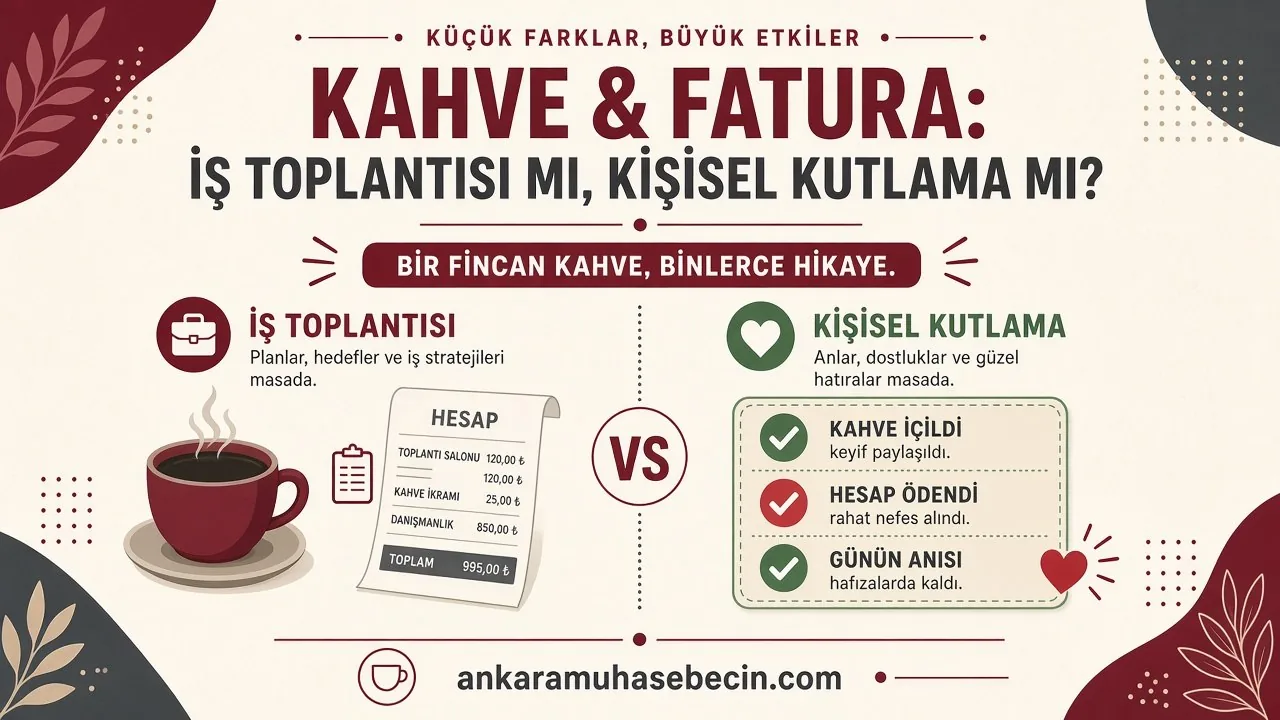
Short answer: Buying a client coffee or lunch is not deductible just because you said “it was for work.” You need a business link, an invoice in the company name, and a reasonable amount with a short note. Family dinners, celebration nights or a card swipe with no receipt weaken the file. Client entertainment, staff meal benefits and office pantry stock are different lines; VAT recovery also follows the document and the nature of the spend.
In Ankara agency, software and advisory files around Kızılay–Çankaya, month-end often starts with: “We were with the client for coffee; I put it on the card.” Relationship-building can be real; the accounting language is nexus, evidence and classification. This is not a “what is entertainment” primer — it is which line belongs in the file and which stays personal. Document rhythm matches the monthly document checklist; for card + subscription discipline see Netflix / Spotify / ChatGPT on the company card. Gift vouchers are a separate door: New Year bonus vs gift voucher.
A business meal is not every meal
An expense must tie to earning or keeping business income. Coffee before a pitch, a short lunch after a delivery meeting, a supplier table for a contract — if the link is real, it is an entertainment candidate. A partner’s birthday, a family restaurant, a “morale night” do not sit on the same link; even on a company card they drift toward private benefit. Limited company or sole trader, the sentence is the same: the payment rail does not rewrite the nature of the spend.
In Ankara practice, amount and frequency also speak. Ten luxury dinners a month with the same client and a thin note strain the “reasonable business need” story. The goal is not to ban hospitality; it is to make who, why and which business step visible in the folder. Small coffee lines are not “irrelevant”; in agency and software teams the count rises and the total becomes visible. Conversely, a one-off higher dinner can be discussed if the business note is clear — reasonableness and frequency are still read together.
“Everyone does it” is not support. In a review or reconciliation the question is how the commercial link is evidenced in the file. That is why a coffee slip sits in the same discipline as a Netflix subscription: the channel is not the story; the document and purpose are.
| Spend | More often an expense candidate | Personal / risky |
|---|---|---|
| Client coffee | Business meeting; company-titled receipt | Friends chat, family; no receipt |
| Lunch / short meal | Pitch or delivery table; attendee + purpose note | Celebration, late night, high amount + empty note |
| Office pantry / tea / water | Workplace consumption; regular supplier invoice | Booking the whole home grocery run as “office” |
| Staff meals | Policy + payroll / contract frame | Cash “food for everyone” with no paper |
| Gift box / chocolate | Business gift policy + invoice | Personal gift; New Year voucher mix |
| Statement only | — | Weak support; missing document |
Who is on the invoice, and what should the note say?
The usual break: personal card plus “we will recharge the company later,” or only a bank statement. Café and restaurant slips should, where possible, carry the company title and tax ID; e-Archive vs e-Invoice follows the taxpayer’s channel — see e-Invoice vs e-Archive. A short line such as “client meeting / guest entertainment” is better than a blank folder. Keeping the counterparty and purpose (pitch, delivery, contract) in the month’s packet helps Ankara reconciliations.
“Meal” alone on the slip is not enough; who and why must be answerable in the file. Just as a foreign SaaS invoice is read apart from a card line, a meal receipt is read apart from the statement. Getting a titled document when you can is stronger than later calling it a company cost. A habitual personal-card + recharge model bloats month-end even for small amounts; keep it exceptional.
FX or foreign restaurants are rarer but appear in travel files. Rate, slip and travel note should sit in one packet; “we were on holiday and called a client” is thin on its own. When travel and meals mix, the business day and business step should be visible.

Entertainment, office cost, payroll: three doors
Do not dump the client table and the office tea stock into one bucket. Workplace consumption is an operating-cost candidate; client hospitality sits in entertainment. Regular staff meal support is usually read under payroll or a contractual fringe; “cash every Friday, no slip” is fragile for tax and social security. Staff-side discipline ties to payroll and social security.
VAT recovery follows a proper document and the nature of the spend. On a line treated as personal, the input-VAT story weakens too. Prefer period filing and advisor classification over memorised rates; uncertain thresholds are confirmed with the current notice or ruling. “There is VAT on the slip, so I recover it” does not settle the nature question.
Sole traders and limited companies may show different chart lines; the question is the same: is this spend part of the trade, or the owner’s private life? If the answer is private, a company card does not rewrite it. That split mirrors the personal-fun versus work-tool split in the subscription article.
Four practical rules in an Ankara file
One: prefer the company card or account; personal card + late recharge should stay exceptional. Two: keep the slip / e-document and a one-line business note in the same month folder. Three: keep family and celebrations off the business table. Four: at month-end gather coffee lines into one packet for accounting — tied to tax advisory or bookkeeping.
In software and agency teams, client coffees are frequent and small. Small does not mean irrelevant; repeated personal lines become visible in total. A five-minute green/red sort before reconciliation speeds the advisor and lowers file risk. Partners working from home in Çankaya or Yenimahalle still pass the same filter for “I was already at work, so every coffee is business”: with whom, which business step?
A one-page internal rule (“client table on company card + note; family and celebrations personal”) cuts slip chaos as the team grows. Policy is not a statute; it keeps the folder consistent.

Frequently asked questions
Is client coffee always deductible?
No. Without a business link, documents and reasonableness it may stay personal.
What if the slip has no company title?
Support weakens. Prefer a titled document; otherwise file risk rises.
Can I pay on a personal card and recharge the company?
Keep it exceptional, not the default. Nexus and documents still matter.
Is office tea the same as client entertainment?
No. Office consumption is separate; the client table sits on the entertainment side.
Are staff meals entertainment?
Usually not; they are read under payroll or fringe rules.
Can I recover the VAT?
If the document and nature fit; on a personal line the recovery story weakens. Confirm with the period file.
Conclusion
Client coffee and meals can grow the relationship; in the books, business link + company document + a short note keep the file standing. Keep celebrations and family tables apart; do not mix office pantry with staff meals. At month-end ask four questions instead of “everything on the statement is an expense”: business, document, note, personal?
At Ankara Muhasebeci in Kızılay we read these lines with folder discipline, not vibes. Find the office on Google Maps. For your list see tax advisory or contact us.