
Short answer: Professional income is documented with a freelance receipt, not a commercial invoice. If the receipt is issued to a business, withholding is 20 percent of the gross fee. VAT is 20 percent of the gross fee. The net fee is gross minus withholding. The amount collected is the net plus VAT. A receipt issued to a consumer does not carry withholding.
The first mix-up in a clinic, a chambers or a home office in Ankara is treating the receipt and the commercial invoice as the same document. A self-employed professional issues a receipt. Commercial income is invoiced. Which one a profession falls under is confirmed with the activity code and the tax-office registration. The rates on this page are the parameters of the freelance receipt calculator on this site.
How do withholding and VAT sit on the receipt?
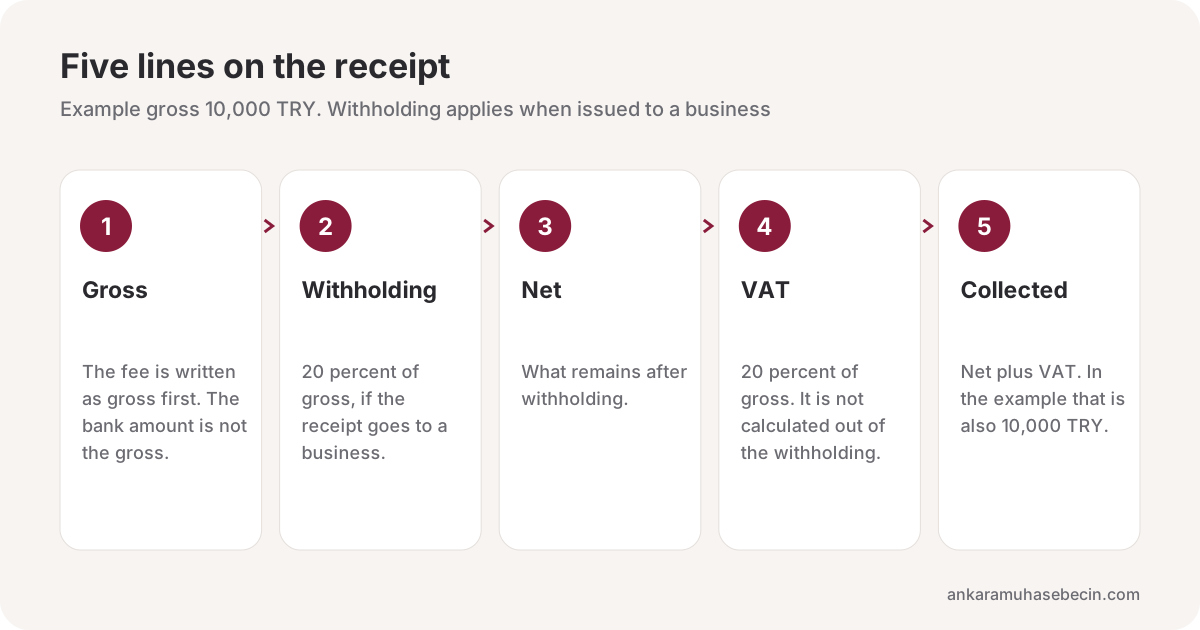
Withholding applies when the receipt is issued to a tax withholder, which is usually a business. The calculation is the gross fee times the withholding rate. The rate in the tool is 20 percent. VAT is also 20 percent of the gross fee. Withholding comes off the gross, not out of the VAT. The amount the client pays is gross minus withholding plus VAT.
The example shows the shape of the calculation. Take a gross fee of 10,000 TRY. Withholding is 2,000 TRY, the net fee is 8,000 TRY and VAT is 2,000 TRY. The amount to collect is 10,000 TRY. That figure is not a tariff. When the gross changes, the three lines change at the same rates. An inclusive amount can also be split in the VAT calculator. The receipt calculation includes withholding, so the two tools are not asking the same question.
| Line | Example: gross 10,000 TRY | How it is found |
|---|---|---|
| Withholding | 2,000 TRY | Gross × 20 percent, if issued to a business |
| Net fee | 8,000 TRY | Gross − withholding |
| VAT | 2,000 TRY | Gross × 20 percent |
| Collected | 10,000 TRY | Net + VAT |
Who withholds, and who does not?
The business reports the withholding on the receipt in its withholding return. The professional offsets the withholding suffered during the year on their own income-tax return. The offset does not mean the withholding never arose. The document should show the same gross in the business’s folder and in the professional’s folder.
If the receipt is issued to a final consumer, withholding is not looked for on the other side. Gross and VAT remain, and the withholding line is empty. The sentence “every receipt has 20 percent withholding” is therefore wrong. The tool assumes a receipt issued to a business. A receipt issued to a consumer is not forced into the same scheme.
A service supplied to a customer abroad is checked against the exemption conditions before the withholding scheme. The customer is abroad, the service is used abroad, and the fee is documented from abroad. A rate is not invented. The conditions are in service export tax exemption. If the exemption does not hold, the receipt enters withholding and VAT like a domestic business receipt.

The electronic receipt and the monthly folder
A freelance receipt can also be issued electronically. That document is the electronic professional receipt. The obligation threshold depends on turnover and on the rules of the period. A threshold is not memorised. The current scope is checked before the receipt routine starts. A professional outside the scope can still join voluntarily. The switch, like the other electronic documents, needs a signature or a financial seal and a channel to issue the document. Setup of the channel is on the e-Transformation page. An e-Invoice and a receipt are not the same document. The invoice split is in e-Invoice vs e-Archive.
At month end the receipt, the collection slip and, where there is one, the document that shows the withholding go into the same folder. A missing receipt stays outside both the income and the deductible VAT. The general order of the folder is in the monthly accounting document checklist. Filing days are in the monthly tax calendar. Provisional tax, outside the simplified method, runs on cumulative profit. The third period’s day is in the Q3 provisional tax guide.
For a self-employed professional, Bağ-Kur is the 4/b insurance that starts with tax registration. The premium is separate from the employee share on a payslip. A rough premium is in the Bağ-Kur premium calculator. A doctor or a lawyer on someone else’s payroll does not enter this receipt routine. Their wage is on the employer’s payslip, and that reading is in how to read a Turkish payslip.
Is the receipt the same as the income ledger?
The receipt is the income line of the ledger. An expense enters with a document too. An expense without a document is left out of the return. The ledger is not a copy of the receipt. The receipt shows the gross, the withholding and the VAT. The ledger carries the period totals of income and expense. They are separate, and they have to agree at month end. If they do not, either the collection was written against the wrong gross or a receipt never entered the folder.
The simplified regime sits outside this article. Professional income is not put in the same mould as commercial income that falls under that regime. Provisional tax, where the conditions are met, runs on a cumulative base. Issuing a receipt does not cancel provisional tax by itself. The condition for the period is checked separately. The third period’s day is in the provisional-tax guide linked above.
Mistakes that repeat
- Issuing a commercial invoice for professional income, or a receipt for commercial income.
- Deducting withholding from the VAT-inclusive amount.
- Writing 20 percent withholding on a receipt issued to a consumer.
- Forgetting to offset, on the annual return, the withholding a business has already cut.
- Calculating VAT on a foreign service without checking the exemption conditions.
- Copying an electronic-receipt threshold from an old article.
The gross on the receipt does not have to equal the amount that landed in the bank. The difference is the direction of withholding and VAT. If 10,000 TRY arrived and the gross is assumed to be 10,000 TRY as well, income is written short or long. The gross is found first. Withholding and VAT are split after that. The scope of the work is on the freelance accounting page.
The office is in Kızılay. A clinic in Çankaya and a practice in Yenimahalle, Keçiören or Etimesgut follow the same receipt routine. The district does not change the withholding rate. What changes it is who the receipt was issued to, and the rate in force.
Frequently asked questions
Is a freelance receipt the same as an invoice?
No. Professional income is documented with a receipt. Commercial income is invoiced. Which one you fall under is confirmed with the activity code and the tax registration.
What is the withholding rate?
If the receipt is issued to a business, the rate in the tool is 20 percent of the gross. A receipt issued to a final consumer does not carry withholding.
Is the amount collected the net fee?
No. Net is gross minus withholding. The amount collected is the net plus VAT. In the example a gross of 10,000 TRY also collects 10,000 TRY. The net is 8,000 TRY.
Is VAT calculated out of the withholding?
No. VAT is on the gross fee. Withholding is also on the gross. Neither is the base of the other.
Is the electronic professional receipt compulsory?
The threshold changes and is checked before the receipt routine starts. Someone outside the scope can join voluntarily. A figure in an old article is not the source.
Does an employee issue a receipt?
A wage on an employer’s payroll is not receipted. The receipt belongs to a person who earns professional income in their own name.
Conclusion
On a freelance receipt, withholding is 20 percent of the gross when the document is issued to a business. VAT is also 20 percent of the gross. Net is gross minus withholding. The amount collected is the net plus VAT. A receipt issued to a consumer has no withholding line.
Ankara Muhasebeci keeps the receipt, the withholding offset and the return on one file, from the Kızılay office. To see your own gross in the tool, open the freelance receipt calculator, or write to us.